
Acoustic vs. Electronic Drums: Which Should You Buy?
Jul 24th 2026
Acoustic vs Electronic Drums: Which One Should You Buy?
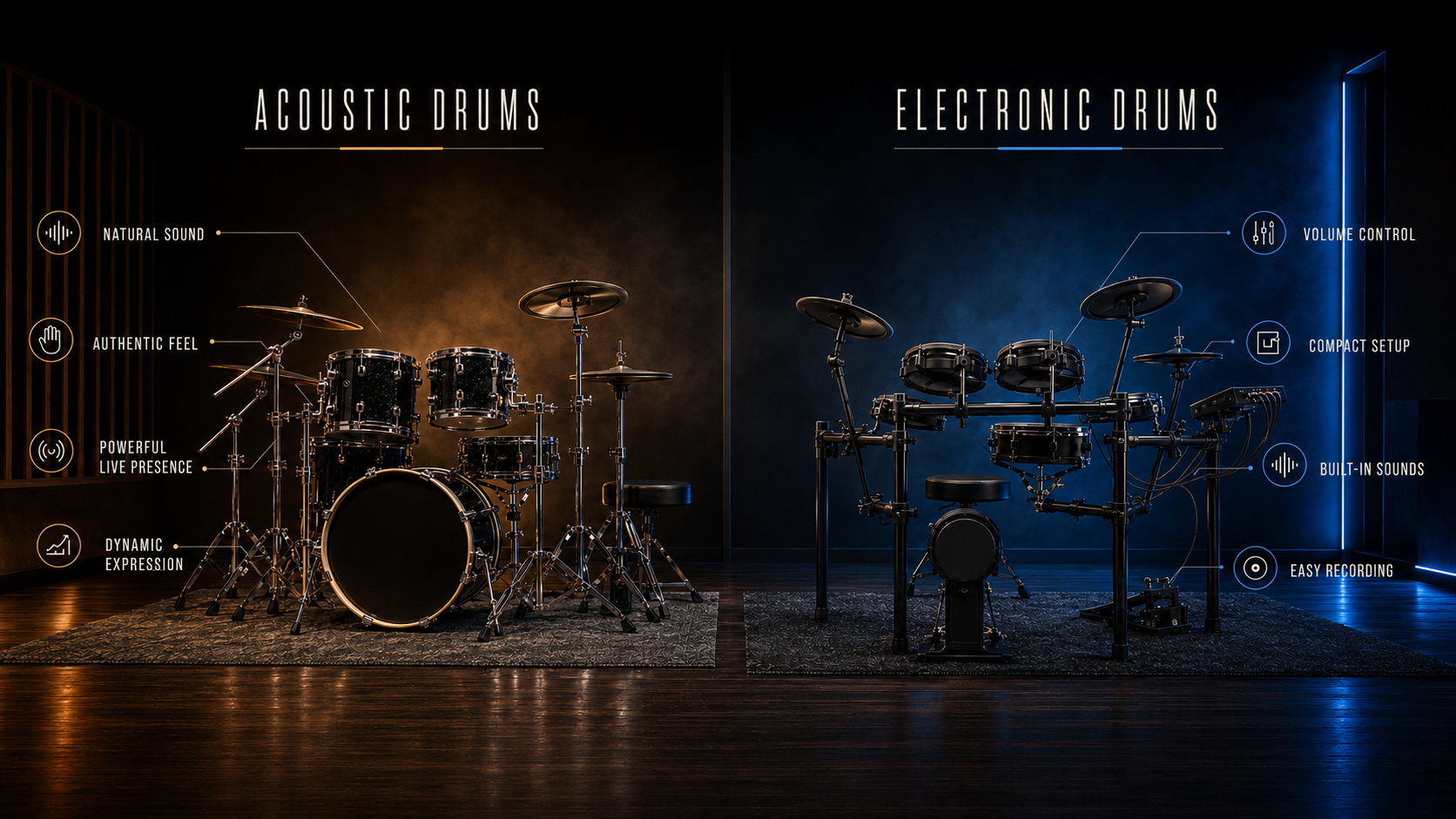
Choosing between acoustic and electronic drums depends less on which type is “better” and more on where, when, and how you plan to play. Acoustic kits deliver natural sound, physical response, and strong live presence. Electronic kits provide volume control, compact dimensions, built-in sounds, and convenient recording.
For most apartment-based beginners and quiet practice sessions, electronic drums are the practical choice. Acoustic drums are generally better for musicians who value authentic feel, dynamic expression, and traditional live performance. This acoustic vs electronic drums comparison will help you choose based on your space, budget, practice routine, and musical goals.
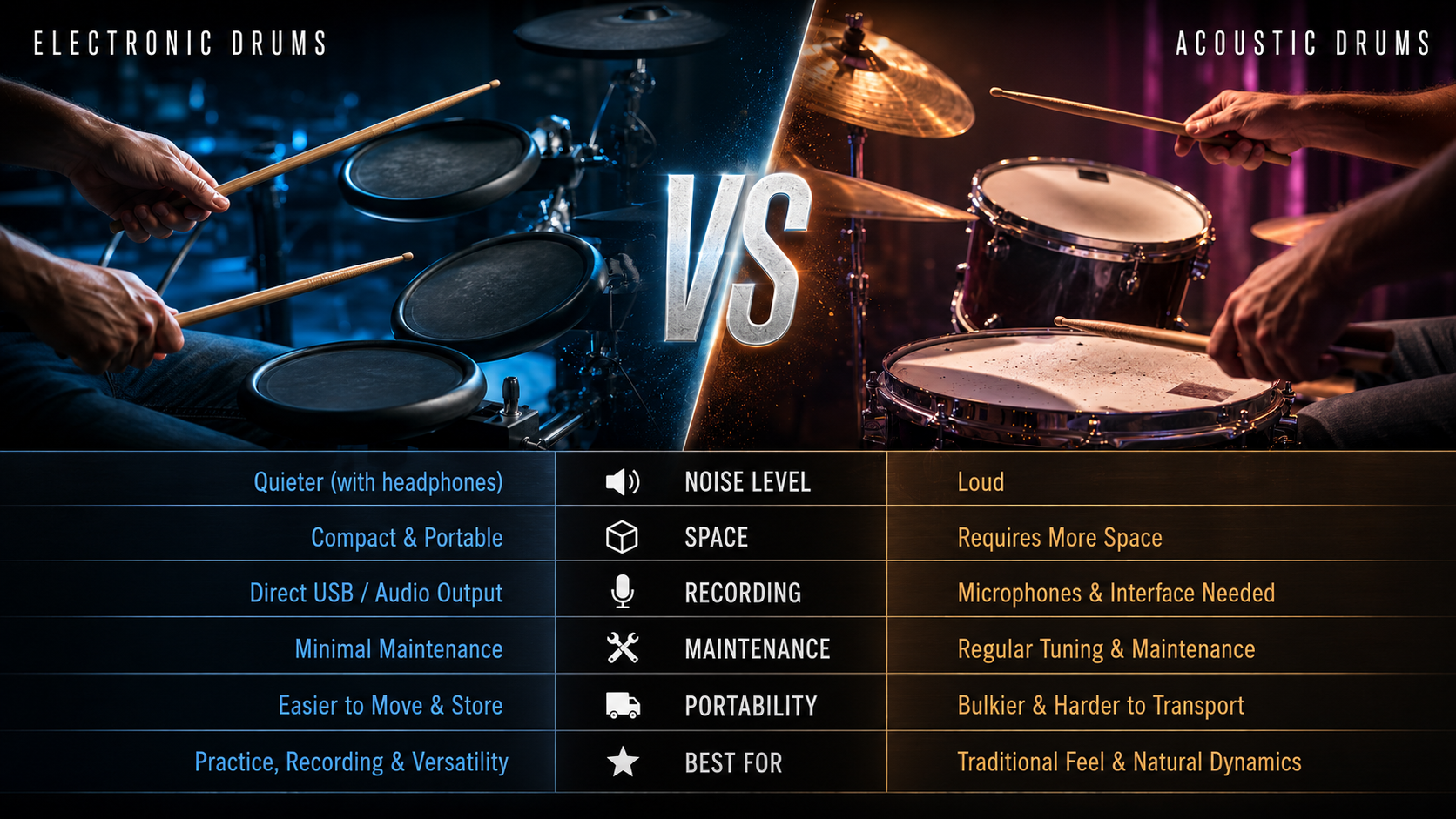
Acoustic vs. Electronic Drums at a Glance
|
Factor |
Acoustic Drums |
Electronic Drums |
|---|---|---|
|
Sound |
Natural and acoustically projected |
Digitally generated through a module |
|
Playing feel |
Most realistic and responsive |
Controlled feel that varies by pad quality |
|
Noise |
Very loud |
Quieter, but pads still create impact noise |
|
Space |
Requires more room |
Usually more compact |
|
Recording |
Requires microphones and an interface |
Often connects directly by USB or audio output |
|
Maintenance |
Tuning and head replacement required |
Minimal routine maintenance |
|
Portability |
Bulky and heavier to transport |
Easier to fold and move |
|
Live use |
Strong natural stage presence |
Consistent sound and simple venue control |
|
Best for |
Authentic performance and technique |
Quiet practice, versatility, and recording |
Sound and Playing Feel: Where Acoustic Drums Lead
An acoustic kit creates sound through real drumheads, shells, and metal cymbals. Every stroke responds to where and how hard you play. Rimshots, ghost notes, cymbal washes, and subtle dynamic changes feel immediate because the instrument produces the sound naturally.
This physical response is one reason acoustic drums remain the standard for many live performers and studio musicians. They help players develop control over touch, tuning, cymbal balance, and natural volume.
Electronic drums use sensors to trigger sampled or modeled sounds stored in a drum module. Better kits can respond to different playing zones and velocity levels, but the experience still depends heavily on pad construction and module quality. Mesh heads usually feel more realistic than basic rubber pads, while multi-zone cymbals offer better expression than single-zone alternatives.
Verdict: Choose acoustic drums for the most natural sound and feel. Choose electronic drums if sound variety and control matter more than complete realism.
Noise and Space: The Practical Difference
Acoustic drums are loud enough to disturb family members, neighbors, or anyone in nearby rooms. Cymbals produce particularly strong high-frequency sound, while the kick drum can transmit vibration through floors and walls. Effective soundproofing can require more than adding foam panels; it may involve structural treatment.
Electronic drums allow you to listen through headphones, making them far more suitable for apartments, bedrooms, and shared homes. However, they are not completely silent. Sticks striking pads create tapping sounds, and kick pedals can transfer impact through the floor. A dense drum mat or isolation platform may reduce that vibration.
Space also matters. A full acoustic kit needs room for drums, cymbal stands, a throne, and safe movement. Electronic kits generally use a compact rack and can sometimes be folded when not in use.
Verdict: Electronic drums are the clear choice when noise restrictions or limited space influence your decision.
Practice and Learning Experience
Electronic kits are designed for convenient practice. Many include a metronome, coaching exercises, play-along tracks, recording functions, and multiple kit sounds. A beginner can practice through headphones at almost any reasonable hour and review recordings without additional equipment.
Acoustic drums offer fewer built-in learning tools, but they teach important physical skills naturally. Players learn to control cymbal volume, tune drumheads, balance each component, and produce a consistent tone without relying on module settings.
Beginners should also consider motivation. A convenient kit that can be played daily is more useful than an ideal instrument that cannot be used because it is too loud.
If you are exploring instruments and performance equipment, visit World of Entertainment to discover solutions suited to different playing environments.
Recording: Convenience vs. Natural Character
Electronic drums make home recording straightforward. Many modules provide USB-MIDI, USB audio, or standard audio outputs. This allows drummers to record a performance directly into compatible software without placing microphones around the kit.
MIDI recording also provides editing flexibility. Notes can be corrected, moved, or assigned different drum sounds after the performance. This is useful for demos, content creation, and home music production.
Recording acoustic drums is more demanding. A basic setup may require microphones, stands, cables, an audio interface, acoustic treatment, and knowledge of microphone placement. The process takes longer, but a well-recorded acoustic kit offers natural depth, room ambience, and character that many musicians prefer.
Verdict: Electronic drums are easier for home recording; acoustic drums offer greater natural character when recorded properly.
Live Performance: Which Works Better?
Acoustic drums deliver visual energy and powerful natural projection on stage. They work particularly well for rock, jazz, blues, and other styles where organic dynamics form part of the performance.
Electronic drums offer different advantages. Their output can be connected directly to a PA system, giving the sound engineer greater control over volume. They also allow performers to switch between multiple kits, percussion sounds, and effects without changing physical instruments.
However, electronic kits depend on amplification, cables, power, and module reliability. Acoustic kits can perform without electronic amplification in smaller spaces, although microphones may still be used at larger events.
A hybrid setup is another option. Combining acoustic drums with triggers or electronic pads gives performers traditional feel alongside samples and effects.
Maintenance, Portability, and Cost
Acoustic drums require regular tuning, occasional drumhead replacement, cymbal care, and hardware inspection. Electronic kits need less routine maintenance, but cables, sensors, pads, and modules may eventually require repair or replacement.
Electronic kits are usually easier to transport because their rack systems can be folded or disassembled. Acoustic drums take longer to pack and may require several cases, especially when multiple stands and cymbals are involved.
Cost should be evaluated as a complete setup:
- An acoustic kit may require cymbals, stands, replacement heads, cases, microphones, and sound treatment.
- An electronic kit may require headphones, an amplifier or PA speaker, a suitable kick pedal, and possibly upgraded pads.
- Entry-level options exist in both categories, while professional configurations can become expensive.
- Used acoustic drums may offer strong value because shells and quality hardware can remain usable for years.
Do not compare only the prices printed on two boxes. Compare everything required to practice, record, transport, or perform.
Which Drum Type Fits Your Situation?
Choose acoustic drums if:
- You have a dedicated practice area.
- Noise is not a major restriction.
- Authentic response is your priority.
- You mainly perform traditional live music.
- You want to develop tuning and acoustic volume control.
Choose electronic drums if:
- You live in an apartment or shared home.
- You need headphone practice.
- Your available space is limited.
- You want simple computer recording.
- You enjoy switching between different sounds.
Choose a hybrid setup if you perform live and want both acoustic expression and electronic samples.
Final Decision
In the acoustic vs electronic drums debate, your environment should guide the purchase. An acoustic kit provides the most authentic sound, response, and stage experience, but it requires space and tolerance for high volume. An electronic kit is compact, versatile, and recording-friendly, making it highly practical for beginners and home musicians.
Before buying, try both types if possible. Test the kick response, snare sensitivity, cymbal movement, rack stability, and overall comfort. If you need help matching a setup to your space, budget, or performance plans, contact the World of Entertainment team for guidance.
Frequently Asked Questions
Are electronic drums good for beginners?
Yes. They support quiet practice and often include learning tools, a metronome, and recording features. A responsive mesh-head kit is preferable when the budget allows.
Can electronic drums be completely silent?
No. Headphones eliminate amplified sound, but sticks and pedals still create tapping and floor vibration.
Can you perform live with electronic drums?
Yes. They connect to a PA system and provide consistent, controllable sound. Reliable amplification and power are essential.
Do skills learned on electronic drums transfer to acoustic drums?
Timing, coordination, and basic technique transfer well. Players may still need to adjust to acoustic cymbal response, rebound, dynamics, and volume control.