
How to Choose a PA System for Live Events
Jul 24th 2026
How to Choose a PA System for Live Events
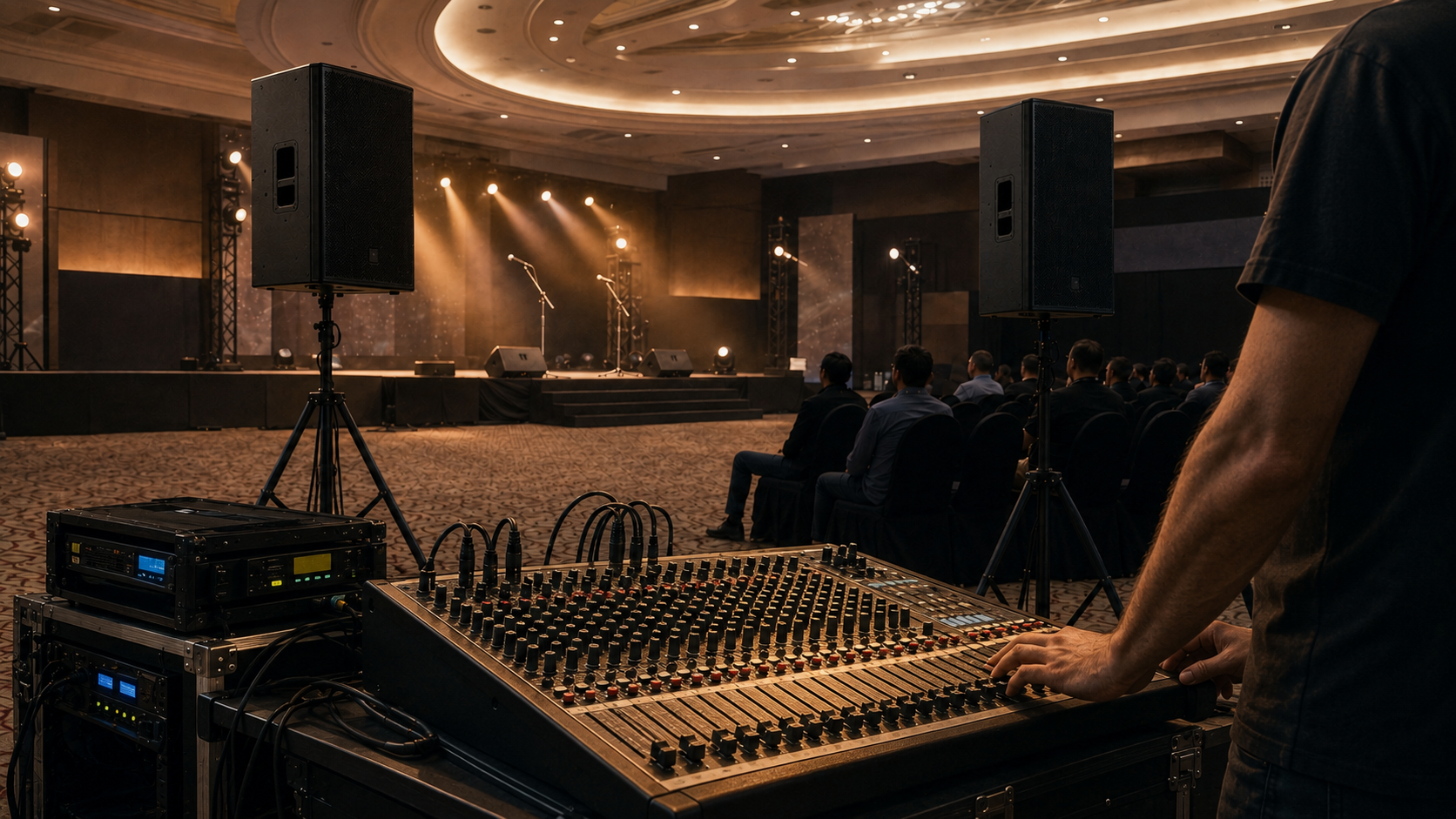
To choose a PA system, begin with the venue, audience, and program, not a wattage number. A speech event may need excellent vocal clarity but little bass, while a DJ event or live band requires greater output, low-frequency support, more mixer channels, and stage monitoring.
A complete system must provide even audience coverage, enough inputs, reliable amplification, suitable microphones, safe stands, and the correct cables. This guide explains how to choose a PA system by working backwards from your event requirements.
Start With the Event, Not the Equipment
Write down everything the PA must reproduce. A presenter with one microphone has a much simpler signal chain than a band with vocals, keyboards, drums, backing tracks, and several monitors.
Your starting brief should identify:
- Event type and expected audience
- Venue dimensions and layout
- Indoor or outdoor location
- Number of microphones and music sources
- Whether performers need stage monitors
- Setup time, transport, and available electrical power
These details reveal how many inputs, speakers, monitor mixes, cables, and operators the event actually requires.
Match Coverage to the Venue and Audience
Audience capacity matters, but headcount alone cannot determine speaker requirements. Two venues with 200 guests may behave very differently if one is a carpeted conference room and the other is a wide outdoor area.
Consider the distance from the stage to the last listener, ceiling height, room width, reflective surfaces, background noise, and whether guests will be seated or standing. The objective is not simply maximum volume; it is consistent, intelligible sound across the listening area.
Main speakers should normally be positioned in front of microphones and raised so sound can travel over the audience. Manufacturer guidance for live-band systems similarly recommends placing main speakers at the front sides of the stage and elevating them around audience-head level to improve coverage and reduce feedback risk.
Indoor and Outdoor Events Need Different Planning
Indoor venues reinforce sound through walls, floors, and ceilings. That can increase perceived loudness, but reflections may reduce speech clarity or make bass uneven. Speaker placement and controlled volume often matter more than adding extra power.
Outdoor sound has fewer reflective surfaces and dissipates more quickly. Wind, audience width, environmental noise, and longer listening distances can all increase system demands. Outdoor equipment also requires protection from moisture, unstable ground, excessive heat, and unsafe electrical conditions.
Never assume that an indoor system will provide the same coverage outdoors simply because the audience size is similar.
Build the System From the Audience Backward
Main Speakers
Main speakers deliver the finished mix to the audience. Powered speakers simplify portable systems because amplification is built in. Passive speakers require compatible external amplifiers but can suit permanent venues and larger centralized installations.
Evaluate speaker coverage, maximum output, input connections, mounting options, processing, weight, and compatibility with the rest of the system. Avoid selecting speakers from peak wattage alone.
Subwoofers
Subwoofers reproduce low frequencies that smaller full-range speakers cannot deliver efficiently. They are valuable for DJs, dance music, electronic music, kick drum, and bass-heavy performances.
Speech events may not need subwoofers. Adding them without a clear purpose increases cost, transport weight, setup time, and crossover requirements.
Stage Monitors
Stage monitors allow performers to hear vocals, instruments, cues, or backing tracks. They require suitable mixer outputs and, ideally, independent monitor mixes.
Place monitors where performers can hear them without pointing directly into the most sensitive part of a microphone. Bands with several performers may require multiple monitor mixes rather than simply adding more wedges to one shared signal.
Select a Mixer With Room to Grow
Count every microphone, instrument, playback device, DJ output, and return signal. Then choose a mixer with more inputs than the current total. Spare channels provide room for last-minute additions and future events.
Check for:
- Enough microphone and line inputs
- Main, monitor, and auxiliary outputs
- Appropriate EQ and signal processing
- Phantom power where compatible condenser microphones require it
- Recording or computer connectivity if needed
- Simple scene or preset recall for recurring events
A small speech system may work with a compact analog mixer. A larger band or production can benefit from a digital mixer offering multiple monitor mixes, processing, remote control, and stored scenes.
Professional speakers, mixers, amplifiers, microphones, and supporting equipment can be explored through World of Entertainment while planning the complete signal chain.
Choose Microphones for Their Actual Jobs
Dynamic handheld microphones are common for live vocals, announcements, and general stage use because they are durable and relatively straightforward to manage.
Lavalier and headset microphones provide hands-free speech for presenters, instructors, and performers. Wireless systems offer mobility but introduce frequency coordination, battery management, receiver placement, and backup requirements.
A practical microphone plan may include:
- Handheld microphones for hosts and singers
- Headset or lavalier microphones for presenters
- Instrument microphones or direct boxes for musicians
- At least one wired backup for critical events
Microphone choice should reflect movement, environment, voice type, placement, and feedback risk, not appearance alone.
Amplification and System Compatibility
Powered speakers contain their own amplifiers. Passive speakers need an external power amplifier or powered mixer that matches their impedance and power-handling requirements.
Do not connect passive speakers directly to an ordinary mixer output. The mixer produces a line-level signal, while passive speakers require amplified power.
For either architecture, confirm that outputs and inputs are electrically compatible. Larger systems may also require system processing, crossovers, delay, limiting, or separate amplification for subwoofers.
Do Not Treat Cables and Stands as Extras
A PA system is only complete when every component can be connected, powered, positioned, and protected safely.
Prepare the correct XLR, TRS, speaker, network, and power cables for your equipment. Carry essential spares and label both ends when several lines run across a stage.
Use speaker stands rated for the cabinet’s weight. Place them on stable ground, extend their legs correctly, and route cables away from walkways. Microphone stands, cable ramps, removable tape, extension leads, and safe power distribution should be included in the plan rather than purchased at the last minute.
Sample PA Configurations by Event Size
|
Event Scale |
Typical Use |
Main PA |
Mixer and Inputs |
Microphones and Monitoring |
|
Small |
Presentation, ceremony, acoustic act |
Two compact powered speakers; subwoofer usually optional |
Compact mixer with spare channels |
1–3 microphones; monitor only if performers need one |
|
Medium |
Wedding, DJ event, small band |
Two higher-output mains plus one or two subwoofers |
Mixer with sufficient inputs and multiple auxiliary outputs |
Several wired/wireless microphones and 1–3 monitor mixes |
|
Large |
Concert, festival, major corporate event |
Scalable main system, subs, fills, and delays where required |
Digital console with stage inputs, processing, and multiple outputs |
Coordinated wireless systems, several monitors or in-ear mixes |
These are planning examples, not universal equipment prescriptions. Venue geometry, required sound level, program material, regulations, and manufacturer specifications must shape the final design. Large events should be designed or reviewed by an experienced sound professional.
Run a Pre-Event System Test
Test the complete PA before guests arrive. Use the same microphones, playback devices, cables, and speaker positions planned for the event.
Walk through the audience area while checking:
- Speech intelligibility from front to back
- Coverage at the sides of the venue
- Feedback margin and microphone handling
- Monitor levels on stage
- Noise, distortion, and cable faults
- Backup playback and microphone operation
If you are uncertain about coverage, amplifier matching, mixer capacity, or cable compatibility, contact our team before ordering.
Final System Recommendation
Choose a compact powered PA for speeches, acoustic performances, and small gatherings where portability and fast setup matter. Add subwoofers, mixer capacity, microphones, and monitor mixes as the program becomes more demanding.
For large venues, permanent installations, or complex live bands, treat the PA as an engineered system rather than a collection of products. Correct coverage, compatibility, redundancy, and safe operation will produce better results than purchasing equipment based only on brand, wattage, or cabinet size.
Frequently Asked Questions
How many speakers does a live event need?
Many small events can begin with two main speakers. Wide, deep, or complex venues may require fills or delay speakers to maintain even coverage.
Does every PA system need a subwoofer?
No. Speech-focused events may not need one. Subwoofers become more valuable for DJs, dance music, bass instruments, and full live bands.
Are powered speakers easier for beginners?
Generally, yes. Built-in amplification reduces component matching and simplifies portable setups, although electrical power is needed at each speaker position.
How many mixer channels should I choose?
Count every planned microphone, instrument, and playback source, then allow spare channels for additions, backups, and future events.