
Portable Stage Buying Guide: Size, Height, Safety & Accessories
Jul 24th 2026
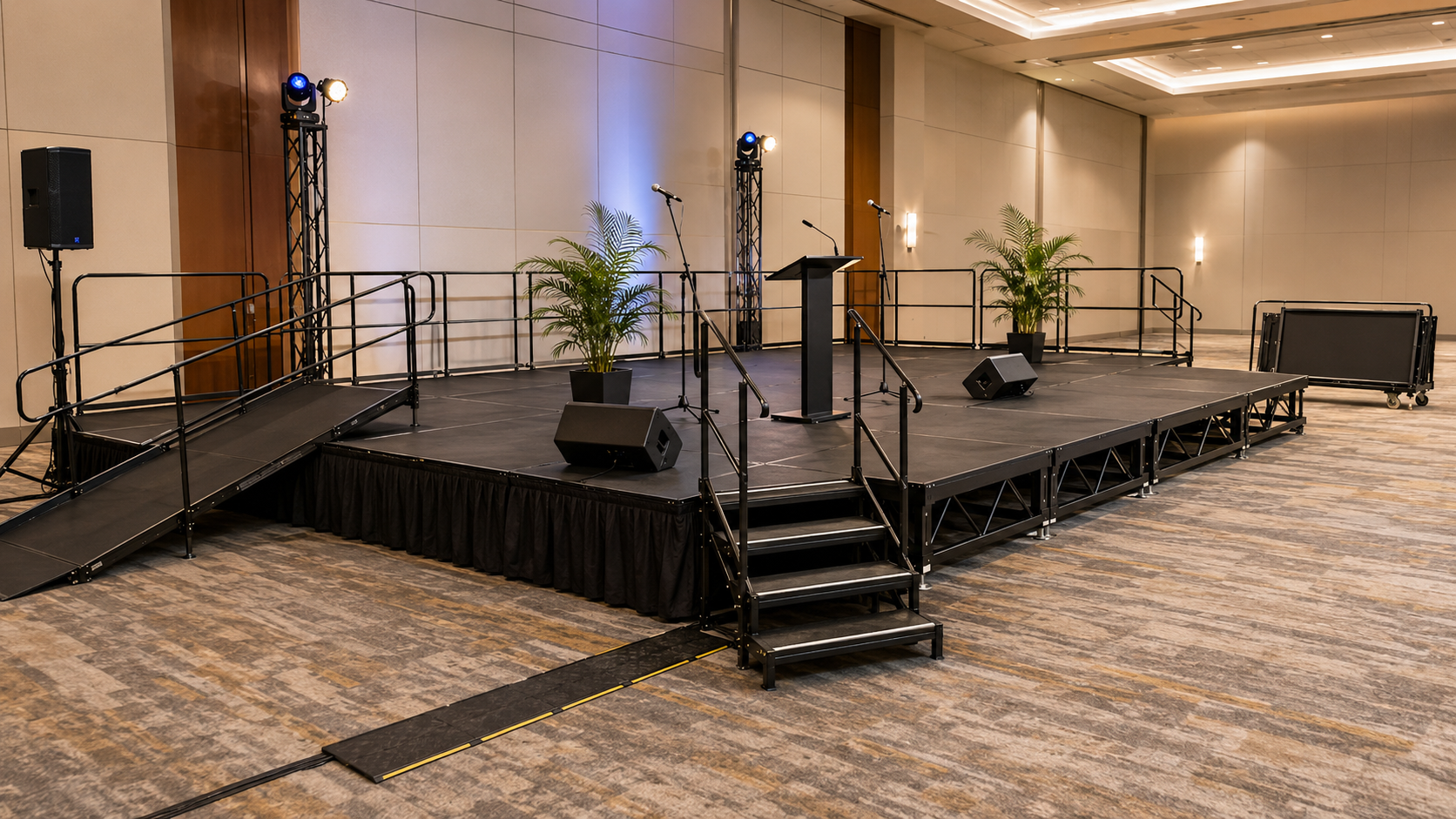
Portable Stage Buying Guide: Size, Height, Safety and Accessories
A portable stage should do more than provide an elevated performance area. It must fit the venue, support the expected activity, offer safe access, and remain practical to transport and store.
Buying solely by platform size can lead to an unstable layout, insufficient space, difficult access, or unnecessary expense. This portable stage buying guide provides a practical framework for selecting a system that works for your events today and can adapt to future requirements.
Begin With the Event, Not the Stage
Before comparing platforms, define how the stage will be used. A school presentation has different requirements from a live band, while a speaker platform does not need the same depth as a stage holding drums, amplifiers, monitors, and performers.
Start with four questions:
- How many people and pieces of equipment will be onstage?
- Will the system be used indoors, outdoors, or in both environments?
- How frequently will it be assembled, transported, and stored?
- Will performers, children, wheelchair users, or members of the public need access?
These answers establish the required dimensions, height, surface, access components, and load rating.
Choose Practical Stage Dimensions
Stage size should reflect the usable performance area, not simply the available floor space. Allow room for people to move without approaching the edges or colliding with equipment.
A solo presenter may only need a compact platform, while a band requires space for instruments, microphone stands, monitors, cables, and safe movement. Choirs and award ceremonies usually benefit from wider configurations, whereas fashion shows may require a long modular runway.
Measure the venue carefully and account for:
- Audience seating and sightlines
- Speaker and lighting positions
- Backdrops, stairs, ramps, and backstage access
- Emergency routes and clearance around the stage
Modular decks are particularly useful because they can be rearranged into rectangles, runways, risers, or multi-level layouts. Explore professional portable staging and event equipment for systems that can expand as your event requirements grow.
Select Height According to Visibility and Access
Greater height can improve audience sightlines, but it also increases access requirements and the consequences of a fall. A low platform may work well in a classroom or small meeting room, while larger audiences and concert environments may require more elevation.
Do not select height for appearance alone. Consider ceiling clearance, stage lighting, performers’ mobility, audience distance, and the space needed for steps or a ramp.
Adjustable legs can make one system suitable for several event types. They are also valuable on slightly uneven surfaces, provided the exact components are approved by the stage manufacturer. Legs should never be improvised, extended beyond their stated range, or placed on an unsuitable base.
Understand Load Ratings
Load capacity is one of the most important specifications in any portable stage purchase. The stage may need to support performers, instruments, speaker cabinets, scenery, furniture, and equipment that creates concentrated pressure in a small area.
Check the manufacturer’s documentation for both uniformly distributed and concentrated load limits where provided. Never assume that a large platform automatically has a high capacity.
Calculate the expected load conservatively, include equipment, and maintain a suitable margin below the published limit. Wheeled equipment, dancing, and energetic performances can introduce movement and forces beyond a motionless load. If requirements are uncertain, obtain approval from the manufacturer or a qualified professional before use.
Match the Stage to Its Environment
Indoor platforms normally operate on predictable, level flooring. Outdoor stages face additional exposure to wind, rain, moisture, temperature changes, and uneven ground.
An outdoor-capable stage should have manufacturer approval for outdoor use, a weather-appropriate deck surface, secure connections, and compatible leveling components. Roofs, banners, backdrops, and attached lighting structures can introduce wind forces; they should not be added unless the complete system is designed and approved for them.
“Water-resistant” does not mean safe in every weather condition. Follow the manufacturer’s weather limits and event safety plan, and suspend use when conditions exceed them.
Inspect the Deck Surface and Connections
A quality deck should feel firm underfoot, resist slipping, and suit the intended environment. Carpeted finishes can look refined in churches and conference rooms, while textured or weather-resistant surfaces may be more appropriate for demanding event use.
Check how individual sections lock together. Proper connectors help prevent gaps, movement, and uneven transitions between decks. Skirting can conceal the supporting structure and improve presentation, but it must not obstruct ventilation, access points, or routine inspection.
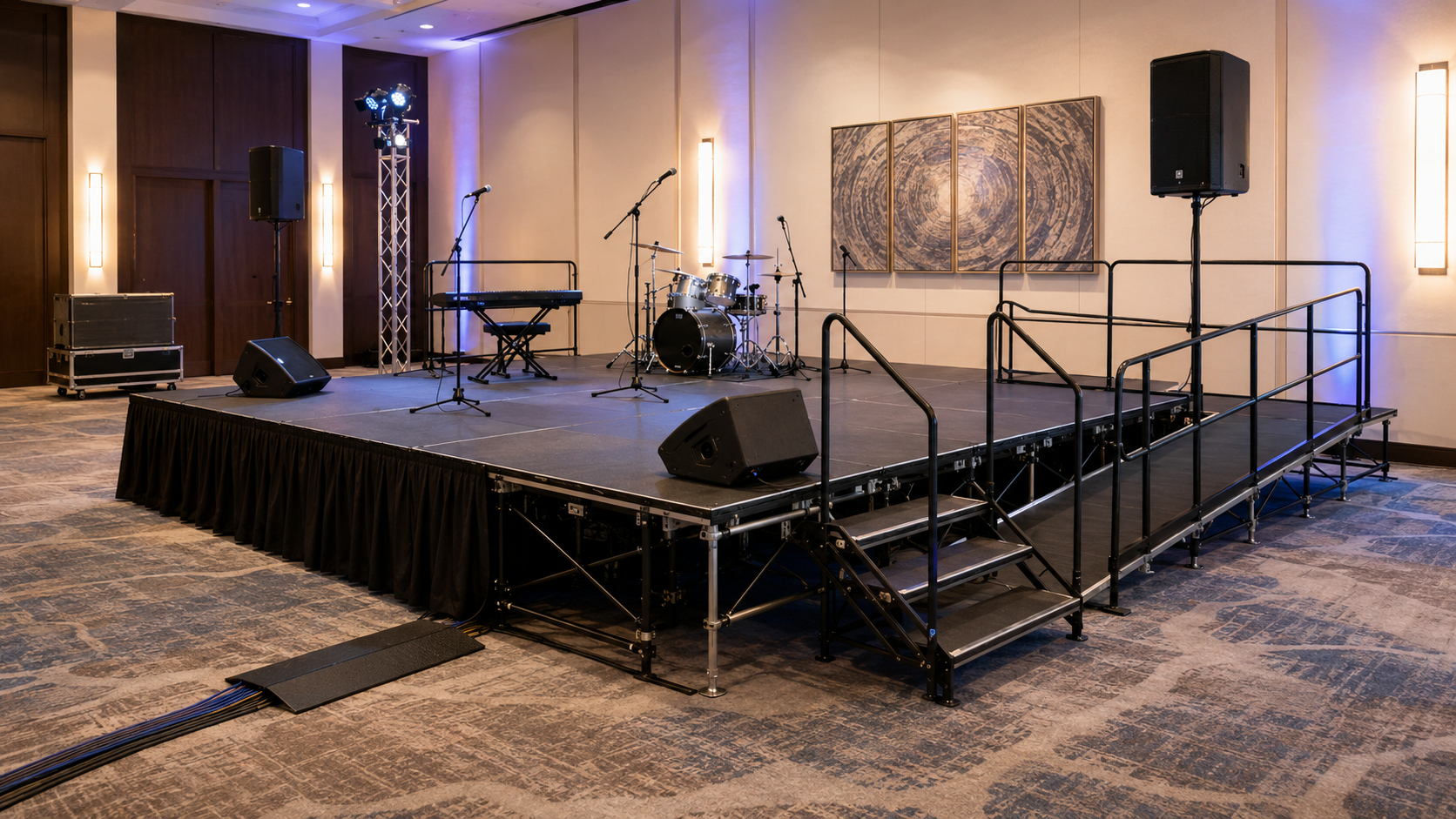
Plan Access as Part of the Purchase
Steps, handrails, guardrails, and ramps should be selected with the stage rather than treated as last-minute additions. Their dimensions and attachment points must be compatible with the specific system.
Accessibility requirements may vary according to venue, event, and local regulations. A ramp also requires considerably more floor space than steps, so include its complete footprint during planning. OSHA guidance emphasizes stable access and appropriate protection from fall hazards, although the exact rules applying to an entertainment stage depend on its use and work environment. Always verify applicable regulations with the venue or a qualified safety professional.
Example Portable Stage Configurations
|
Event type |
Practical configuration |
Features to prioritize |
|
Presentation or school assembly |
Low, compact platform |
Simple access, durable surface, easy storage |
|
Church or choir |
Wide stage or tiered risers |
Quiet deck, steps, rails, flexible expansion |
|
Wedding or DJ event |
Medium modular platform |
Clean finish, skirting, cable management |
|
Live band performance |
Deep, reinforced layout |
Verified load rating, equipment space, multiple access points |
|
Outdoor community event |
Weather-approved modular system |
Leveling, secure connections, slip resistance |
These are planning examples rather than universal specifications. Final dimensions and accessories should reflect the actual venue, occupancy, equipment, and manufacturer instructions.
Think Beyond the Initial Event
Portable staging creates long-term value when it is easy to move, assemble, expand, and repair. Before purchasing, check the weight of each deck, the number of people required for installation, trolley compatibility, storage footprint, and availability of replacement parts.
Useful accessories may include transport carts, storage racks, deck connectors, adjustable legs, steps, ramps, rails, skirting, and cable-management products. Buy only components approved for the selected system; mixing incompatible parts may affect stability and invalidate manufacturer guidance.
If you're unsure which staging system and accessories best fit your venue, get in touch before ordering.
Final Safety Check Before Every Event
Inspect all decks, legs, braces, locks, rails, steps, and connectors before opening the stage. Confirm that the supporting surface is firm and level, every component is fully engaged, cables do not create trip hazards, and the layout remains within its rated capacity.
Installation should follow the manufacturer’s current instructions and applicable local rules. Damaged, modified, or unidentified components should remain out of service until assessed or replaced.
Frequently Asked Questions
What is the best portable stage size?
The best size depends on the number of performers, equipment footprint, access space, and venue dimensions. Plan for movement rather than fitting everything tightly.
Can a portable stage be used outdoors?
Only when the manufacturer approves that system for outdoor use and its limits for weather, surface conditions, anchoring, and accessories are followed.
Are adjustable stage legs safe?
Yes, when they are compatible manufacturer-approved components, used within their rated height range, and installed on a suitable surface.
Do I need rails and steps for a low stage?
Requirements vary by stage design, height, users, venue, and local regulations. Follow the manufacturer’s instructions and confirm applicable safety and accessibility rules.