
Powered vs. Passive Speakers: Which Is Better?
Jul 24th 2026
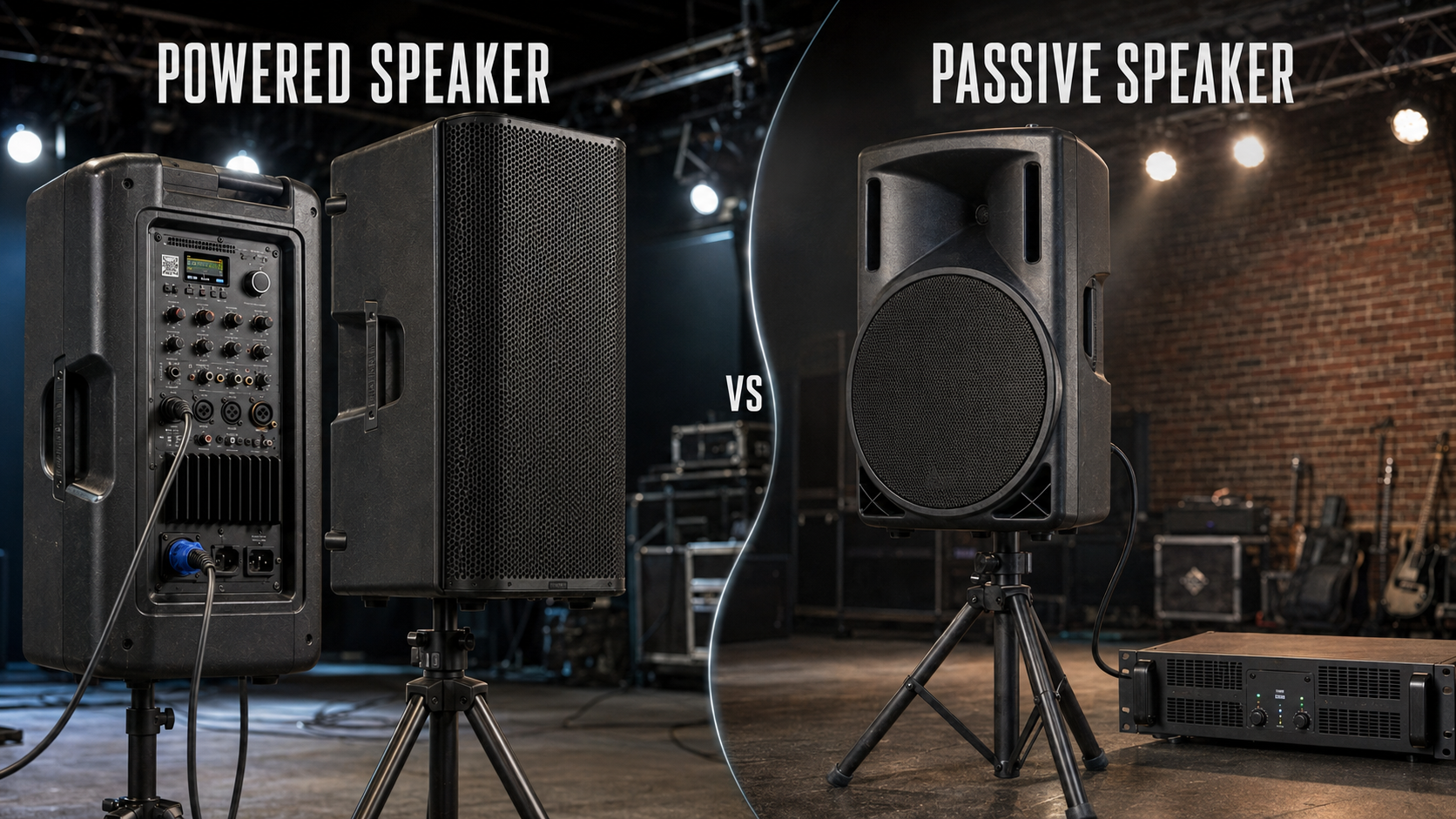
Powered vs Passive Speakers: Which Is Better for Your Setup?
Powered speakers are generally better for mobile DJs, solo performers, and small-event teams that need a fast, portable system. Passive speakers are often better for permanent venues, larger installations, and expandable sound systems where amplifiers and processing are managed from a central location.
Neither design is universally superior. The right choice in the powered vs passive speakers comparison depends on how often the system moves, who operates it, how much expansion you expect, and whether you prefer integrated or separate components.
The Core Difference Is Amplification
Every speaker requires amplification to convert an audio signal into sound. The main difference is where that amplification is located.
Powered Speakers
A powered or active speaker contains an amplifier inside its enclosure. Connect the speaker to electrical power, send it an audio signal from a mixer or controller, and it can operate without a separate power amplifier.
Many current powered PA speakers also include built-in digital signal processing, level controls, presets, protection, or basic mixing functions. Their integrated design reduces the need for external amplifier racks and supports plug-and-play operation.
Passive Speakers
A passive speaker does not contain its own power amplifier. It receives an amplified signal from an external amplifier or powered mixer through a speaker cable.
The amplifier must be compatible with the speaker’s impedance and power-handling specifications. Matching should never be based on wattage alone. Impedance, continuous power ratings, system processing, and available headroom must also be considered.
Setup Complexity: Speed or Control?
Powered speakers simplify small and medium setups because amplification is already matched and installed inside each enclosure. The operator does not need to select an external amplifier or build a separate equipment rack.
A basic powered system may only require:
- A mixer or DJ controller
- Two powered speakers
- Audio cables
- Electrical connections
- Speaker stands
Passive systems involve more planning. The speakers connect to an amplifier, while the mixer or signal processor connects to the amplifier’s inputs. Larger systems may also require crossovers, limiters, rack-mounted processing, and carefully planned speaker wiring.
This additional complexity is not necessarily a disadvantage. A properly designed passive system gives experienced technicians centralized control over amplification and processing.
Portability Is More Than Speaker Weight
Powered speakers contain amplifiers, power supplies, and sometimes processing, so each cabinet may be heavier than a comparable passive enclosure. However, the complete system can still be easier to transport because no separate amplifier rack is required.
That makes powered speakers attractive for DJs, musicians, fitness instructors, presenters, and event teams that frequently load equipment into vehicles.
Passive speakers may be lighter individually, but the amplifier rack adds weight and occupies additional space. This arrangement can still work well for touring productions because amplifiers, processing, and power distribution can travel together in organized racks.
For portability, evaluate the entire system, not just one speaker.
Cabling and Power Distribution
Powered speakers require two types of connections: an audio cable and an electrical power connection. If speakers are placed far apart, safe power must be available near each cabinet.
Passive speakers need speaker cables from the amplifier but do not require individual electrical outlets at every speaker position. This can make them useful for fixed installations or areas where local power access is limited.
The practical difference is:
- Powered systems distribute electrical power around the venue.
- Passive systems distribute amplified speaker-level signals from a central rack.
- Both require correct cable types, safe routing, and secure connections.
Never substitute instrument or microphone cables for proper speaker cables in a passive system. Cable length and conductor size can also influence power loss, especially across longer runs.
Maintenance and Fault Management
With powered speakers, the amplifier and speaker are housed together. If an internal amplifier fails, that cabinet may become unavailable until it is repaired. Servicing can also require moving the complete speaker.
However, powered systems are easier to troubleshoot in small setups. Each speaker functions as a relatively independent unit, and a problem with one cabinet may not stop the other from operating.
Passive systems separate the speaker from the amplifier. A failed amplifier channel may be replaced or reassigned without removing the speaker enclosure. Technicians can inspect and maintain amplifiers from one central rack.
This makes passive architecture attractive for venues that employ technical staff and need serviceable, scalable systems.
Expansion and Upgrade Potential
A powered system is easy to expand on a small scale. Additional powered speakers or subwoofers can often be connected through appropriate mixer outputs or speaker link connections. However, every added cabinet needs both signal and electrical power.
Passive systems offer greater flexibility for planned installations. One suitable amplifier may power multiple compatible speakers, while larger systems can use dedicated amplifiers for different zones or frequency ranges.
Before expanding either system, consider:
- Mixer output capacity
- Speaker and subwoofer compatibility
- Amplifier loading and impedance
- Signal processing and crossover requirements
- Electrical capacity and safe power distribution
Expansion should follow a system plan. Simply adding more speakers can create uneven coverage, phase problems, or unsafe amplifier loads.
Initial Cost vs. Long-Term Cost
Powered speakers may appear more expensive per cabinet because amplification and processing are included. However, the buyer does not need to purchase a separate amplifier immediately. This can make the overall starting cost competitive for smaller systems.
Passive speakers often cost less per enclosure, but the complete budget must include an amplifier, equipment rack, speaker cables, processing, and professional system configuration where necessary.
Long-term value depends on scale. Powered speakers can be economical when each unit operates independently and moves frequently. Passive systems may offer better value when many speakers share centralized amplifiers or when individual components are upgraded separately.
Which Speaker System Fits Your Use?
| Buyer or Application | Better Starting Choice | Main Reason |
|---|---|---|
| Beginner or solo performer | Powered | Easier setup and fewer components |
| Mobile DJ | Powered | Fast deployment and no amplifier rack |
| Small live event | Powered | Simple operation and flexible placement |
| Permanent venue | Passive | Centralized amplification and maintenance |
| Multi-zone installation | Passive | Easier planned distribution and expansion |
| Large production company | Depends on system design | Scale, staffing, transport, and redundancy matter |
This matrix provides a starting point rather than an absolute rule. Professional powered systems can support large events, while compact passive systems can work effectively for smaller venues.
Practical Recommendations by Event Type
Choose Powered Speakers When:
- The system must be set up and removed quickly.
- One person manages both performance and sound.
- Equipment is transported frequently.
- You want amplification matched within each cabinet.
- The setup serves small or medium events.
Powered speakers are especially practical for mobile DJs, acoustic performers, presentations, private parties, and portable stage-monitor systems.
Choose Passive Speakers When:
- The equipment will remain permanently installed.
- Several speakers share a centralized system.
- Technical staff will manage amplification and processing.
- Individual amplifiers or speakers may need separate upgrades.
- Electrical power near every speaker is difficult to provide.
Passive systems are common choices for houses of worship, schools, clubs, theatres, and structured multi-speaker installations.
Browse professional speakers, amplifiers, powered mixers, and audio accessories through World of Entertainment when planning your complete signal chain.
Final Verdict
Choose powered speakers when convenience, portability, and fast setup are the priorities. Choose passive speakers when centralized control, serviceability, and large-scale expansion matter more.
Do not make the decision from speaker price or wattage alone. Consider the mixer, amplification, processing, cabling, electrical power, venue size, and people responsible for operating the system. If you need help matching speakers with amplifiers, mixers, or cables, get in touch before purchasing.
Frequently Asked Questions
Do powered speakers need an amplifier?
They contain built-in amplification, so a separate external power amplifier is normally unnecessary.
Can passive speakers connect directly to a DJ controller?
No. A DJ controller outputs an audio signal, but passive speakers require a compatible power amplifier or powered mixer.
Are powered speakers better for DJs?
They are often more convenient for mobile DJs because they reduce setup components and eliminate a separate amplifier rack.
Can powered and passive speakers be used together?
Yes, but the signal routing and amplification must be designed correctly. Passive speakers still require a compatible external amplifier.