
Truss vs Lighting Stands: Which Is Better?
Jul 24th 2026
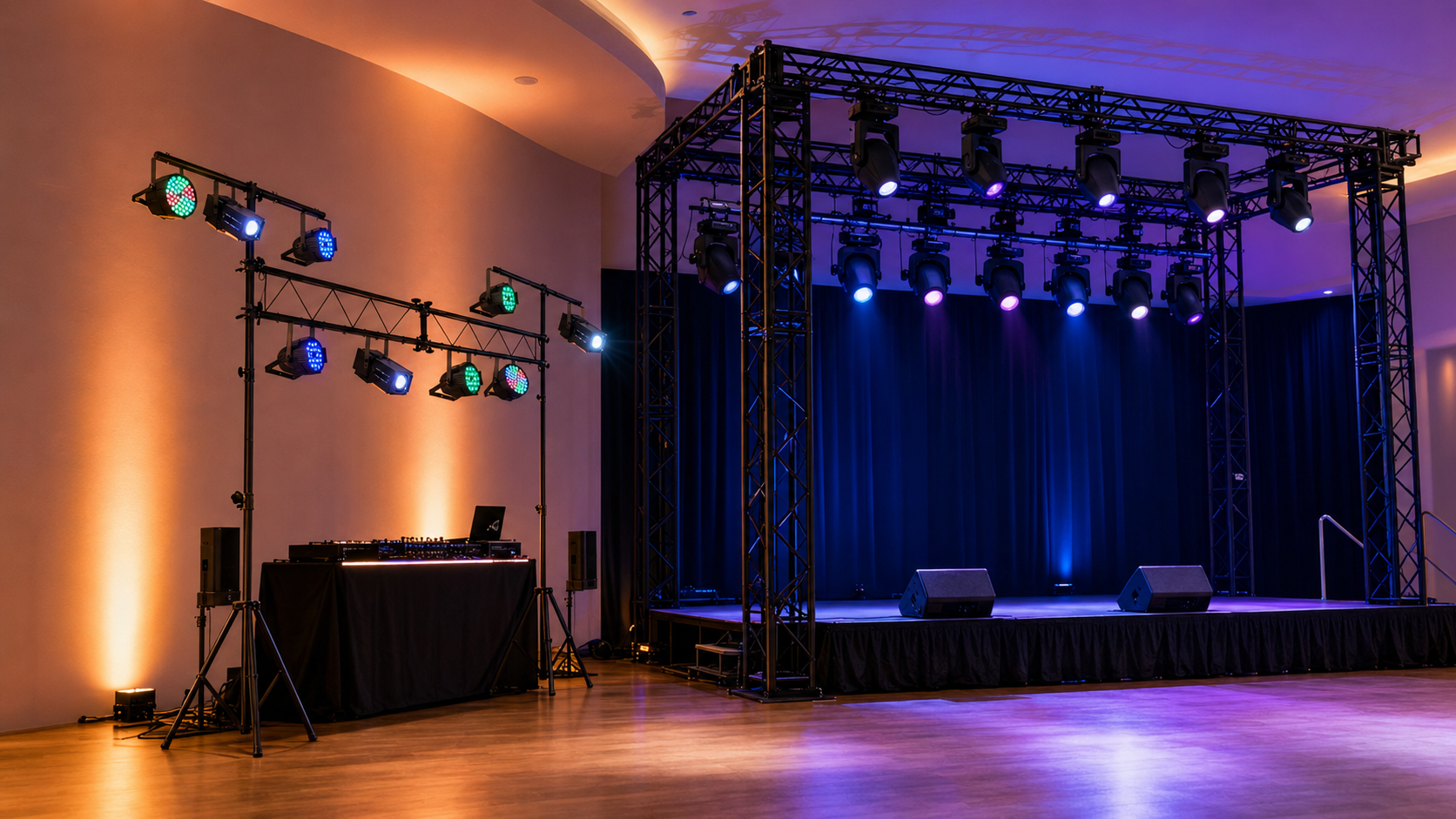
Truss vs Lighting Stands: Which Is Better for Your Event?
Lighting stands are usually the practical choice for small weddings, mobile DJ events, and compact stages using a limited number of lightweight fixtures. Truss systems become more appropriate when an event requires wider fixture distribution, greater expandability, professional presentation, or a structure designed for heavier and more complex production loads.
The truss vs lighting stands decision should pass three tests: Can the system safely support the complete load? Does it provide the required lighting positions? Can the crew assemble and operate it correctly within the venue?
Gate One: Calculate the Real Load
Do not compare support systems using fixture quantity alone. Ten compact PAR lights may weigh less than two large moving heads.
The total load includes:
- Lighting fixtures and brackets
- Clamps, cables, adapters, and safety accessories
- Controllers, power distribution, or mounted effects
- Any banners, screens, or scenic items approved for the structure
- Dynamic forces and uneven fixture placement
Every stand, crossbar, truss section, connector, base, tower, and lifting component has its own manufacturer rating. Capacity can change with span length, load position, configuration, height, and support method.
A truss is not automatically capable of carrying any production load. Manufacturers publish configuration-specific allowable load data because a distributed load behaves differently from a concentrated center load. Always check the manufacturer's load specifications for the exact truss configuration before installation.
Gate Two: Match the Structure to the Event
When Lighting Stands Are Sufficient
Tripod and T-bar lighting stands work well when fixtures can be grouped into a few positions. A mobile DJ may place one stand on each side of the booth, while a small ceremony could use stands to support PARs or compact effects.
Lighting stands are useful when:
- The fixture package is lightweight and limited
- Fast setup and breakdown are priorities
- Equipment must fit into a smaller vehicle
- The venue provides no permanent rigging points
- The event does not require a long overhead lighting line
Their main limitation is concentration. Several fixtures placed on one bar create a crowded visual appearance and can make balanced loading more difficult.
When Trussing Becomes the Better Tool
Truss creates a longer, more organized mounting surface. It can distribute fixtures across a stage, support symmetrical designs, and provide cleaner sightlines than multiple independent stands.
Ground-supported truss systems can form goalposts, arches, or larger grids. Flown truss introduces additional engineering, hoisting, inspection, and venue-approval requirements and should never be treated as a simple DIY upgrade.
Trussing is better suited to concerts, theaters, corporate productions, large weddings, and events using multiple moving heads, washes, effects, screens, or scenic elements.
Truss vs Lighting Stands at a Glance
| Factor | Lighting Stands | Truss System |
|---|---|---|
| Best use | Small, portable lighting packages | Medium to large structured productions |
| Load planning | Based on stand, bar, height, and balance ratings | Based on span, configuration, support points, and load tables |
| Setup time | Generally faster | Longer; may require a trained crew |
| Portability | Easier for one or two people | Requires more transport and storage space |
| Fixture positions | Limited and concentrated | Wider, cleaner distribution |
| Appearance | Functional but equipment-visible | More integrated and professional |
| Expansion | Limited by stand and bar ratings | Modular when correctly designed |
| Cost | Lower starting investment | Higher equipment, labor, and transport cost |
| Safety complexity | Moderate | High, especially for elevated or flown systems |
Gate Three: Check Stability in the Actual Venue
A support system that appears stable in a warehouse may behave differently on carpet, an uneven outdoor surface, a crowded dance floor, or near moving guests.
Lighting stands have legs extending into the working area. Their height and footprint must be managed carefully, and barriers may be needed to prevent guests from touching or striking them. Raising a top-heavy stand can also reduce stability.
Truss systems may use base plates, towers, outriggers, ballast, or approved anchoring. Outdoor structures introduce wind loading, weather monitoring, ground conditions, and emergency action requirements. Banners and screens can act like sails and must never be added casually.
The safest option is not always the heaviest-looking structure. It is the system that has been properly designed, rated, assembled, secured, inspected, and operated for its exact configuration.
Setup Time and Crew Requirements
Lighting stands are attractive to mobile DJs because they can be positioned and loaded quickly. Fixtures may be mounted at ground level before the bar is raised, provided the manufacturer’s process is followed.
Truss requires more components and more deliberate assembly. Sections, pins, bolts, towers, bases, hoists, clamps, and safety accessories must be inspected and installed correctly. Larger systems also require a coordinated build area and controlled lifting procedure.
Professional truss training emphasizes assembly, inspection, load capacity, and practical rigging safety rather than treating truss as decoration.
Appearance and Audience Experience
Lighting stands are perfectly acceptable when they can be placed discreetly at stage edges or behind a DJ booth. Black stands and tidy cabling can reduce visual distraction.
Truss becomes part of the event architecture. It creates a defined stage frame and provides organized positions for lighting. It can also support a more polished production look when its bases, cables, and connections are managed professionally.
Explore trussing, lighting supports, fixtures, and event-production equipment only after identifying the required mounting positions and complete load.
Cost: Compare the Complete System
Lighting stands cost less initially and require fewer connectors, cases, and crew members. However, purchasing many individual stands can create clutter and may eventually limit expansion.
A truss budget can include:
- Truss sections, corners, and connectors
- Towers, bases, outriggers, or approved support structures
- Clamps and rated safety accessories
- Transport cases and storage
- Qualified design, rigging labor, inspection, and venue approval
Truss may offer better long-term flexibility for a production company, but it is rarely the cheapest answer for a small event.
Choose by Event Profile
Choose lighting stands for a small DJ setup, ceremony, private party, or compact stage with a few lightweight fixtures and frequent transportation.
Choose ground-supported truss when you need wider fixture spacing, a defined stage frame, cleaner presentation, and planned expansion.
Use flown truss only when venue conditions, engineering, rigging points, equipment, documentation, and qualified personnel support it. OSHA describes a competent person as someone able to identify predictable hazards and authorized to correct them; complex overhead work may also require qualified design and specialized rigging expertise.
If you're unsure about the correct configuration or compatible components, get in touch before purchasing.
Final Decision
Lighting stands win on portability, speed, and affordability. Truss wins on fixture distribution, presentation, and properly engineered expandability.
Do not upgrade to truss simply because it looks professional. Upgrade when your fixture package, venue, mounting positions, and production requirements genuinely need a designed structural system.
Frequently Asked Questions
Can moving heads be mounted on lighting stands?
Yes, when the stand, bar, adapters, and mounting method are rated for the complete load and the fixture has safe movement clearance.
Is truss safer than lighting stands?
Not automatically. Either system can become unsafe through overloading, poor assembly, incorrect ballast, unstable placement, or unauthorized modification.
How many lights can a T-bar hold?
There is no universal number. Follow the manufacturer’s load rating and consider fixture weight, bar capacity, balance, stand height, and approved mounting points.
Can event truss be installed without a professional?
Small manufacturer-approved ground systems may be straightforward for trained users. Flown, hoisted, outdoor, or complex structures require qualified planning and rigging.